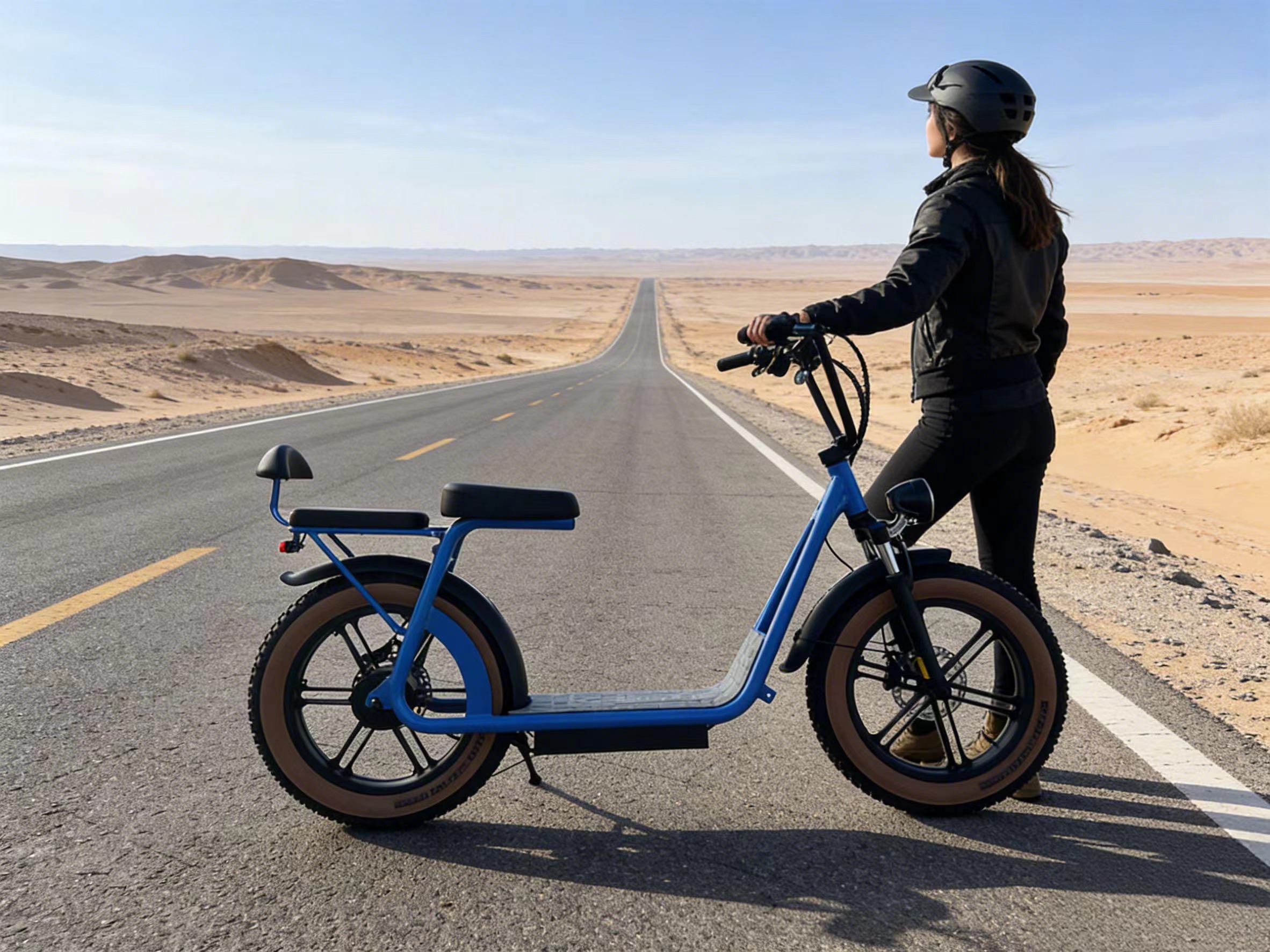
Product Type:Recreation & Outdoor
Product Introduction:Electric Scooters for Recreation & Outdoor Adventures Outdoor riding creates different requirements from urban commuting. ...
Outdoor riding creates different requirements from urban commuting.
Instead of focusing only on paved roads and traffic, outdoor riders may encounter gravel, dirt paths, uneven pavement, inclines and changing terrain.
For these environments, vehicle design becomes particularly important.
Tires, suspension, frame construction, battery capacity, braking and rider position all influence how an electric vehicle performs outside conventional city streets.
An outdoor electric scooter is generally designed to provide greater versatility across a wider range of surfaces than a lightweight urban scooter.
Typical characteristics may include:
However, “off-road” should not automatically mean every type of terrain is suitable. Riders should always follow the manufacturer’s intended use.
20×4.0-inch tires, for example, provide a significantly different riding experience from narrow commuter tires.
The larger contact area can provide additional stability and cushioning on suitable surfaces.
Fat tires can be particularly useful for:
Tire pressure also affects handling and comfort, so proper setup is important.
Suspension helps manage impacts from uneven surfaces.
For recreational riding, suspension can improve comfort when riding over:
But suspension is only one part of the equation.
Frame geometry, wheel size, tire pressure and rider position also influence overall stability.
Outdoor riding can consume more energy than steady-speed urban riding.
Factors include:
Therefore, advertised range should be treated as an estimate rather than a guaranteed distance.
For longer recreational trips, removable batteries can offer an additional practical advantage because spare batteries can potentially be prepared in advance, where the vehicle design allows it.
Electric scooters and e-bikes can also be useful inside private outdoor environments.
Examples include:
In these environments, electric vehicles can provide quiet and convenient short-distance transportation.
It is important to distinguish between recreational outdoor riding and extreme off-road riding.
A fat-tire electric scooter may be well suited to gravel roads and maintained trails but may not be designed for jumps, deep mud, technical mountain trails or aggressive off-road riding.
This distinction is important for both product selection and customer communication.
Look for appropriate tire size, suspension, braking, battery capacity, ground clearance and frame construction based on the terrain you intend to ride.
Fat tires can improve stability and cushioning on many loose or uneven surfaces, but they do not automatically make a vehicle suitable for every off-road environment.
Electric scooters and e-bikes can be useful for transportation within suitable campgrounds and private properties, subject to site rules.
Range depends on battery capacity, motor power, terrain, rider weight, speed, temperature and riding conditions. Manufacturer range figures should be treated as test-condition estimates.