Product Type:Industry Insights
Product Introduction:The Rise of the Performance Electric Cruiser: A New Direction in Electric Mobility The electric two-wheel market is no longer ...
The electric two-wheel market is no longer limited to the traditional e-bike.
Over the past several years, manufacturers have developed products for commuting, cargo transportation, recreation, off-road riding and short-distance urban mobility. At the same time, consumers have become more interested in vehicles that provide a different riding experience rather than simply replacing a conventional bicycle with an electric motor.
This has created space for a category that sits between the traditional e-bike and more motorcycle-oriented electric vehicles: the performance electric cruiser.
The category is still developing. There is no single international definition of an electric cruiser, and products can differ significantly in power, speed, geometry and legal classification.
What they share is a design philosophy.
A performance electric cruiser should not be defined simply by motor wattage.
A 2000W motor installed on a conventional bicycle frame does not automatically create a cruiser.
Cruiser-oriented electric vehicles generally combine several characteristics:
The purpose is to create a vehicle that feels stable and comfortable while providing more electric performance than a conventional low-power bicycle.
This changes the engineering priorities.
Traditional bicycles are often designed around pedaling efficiency and responsive handling.
A cruiser takes a different approach.
A longer wheelbase can make the vehicle feel more planted at speed, while a lower seating position can contribute to a lower center of gravity.
The trade-off is maneuverability.
A longer wheelbase usually requires more space to turn and can feel less agile than a short-wheelbase bicycle.
For recreational riding, however, that trade-off can make sense.
The rider may value predictable handling more than rapid steering response.
Wide tires are another defining characteristic of many electric cruisers.
A 20×4.0 tire provides a large volume of air and a substantial contact area. Tire pressure can then be used as part of the ride-quality setup.
The result can be a more compliant ride over uneven surfaces.
There are disadvantages. Fat tires add weight and can increase rolling resistance.
Therefore, they are not necessarily the most efficient choice for a lightweight commuter.
They make more sense when comfort, stability and visual presence are part of the product proposition.
Performance electric cruisers also tend to move toward higher-voltage electrical systems.
A 60V system, for example, can support higher power without requiring the same current as a lower-voltage system at an equivalent power level.
That does not mean a 60V vehicle automatically has more range or speed.
Actual performance depends on the motor, controller, battery, wheel size, vehicle weight and software settings.
The electrical system must also be matched with the mechanical systems.
More power requires greater attention to braking, tires, suspension and structural strength.
For longer recreational rides, battery flexibility becomes increasingly important.
A removable battery allows the rider to charge the battery separately from the vehicle.
A dual-battery platform can provide additional energy capacity while retaining a modular approach to battery servicing and replacement.
This is particularly relevant to electric cruisers because their applications can extend beyond short daily commuting.
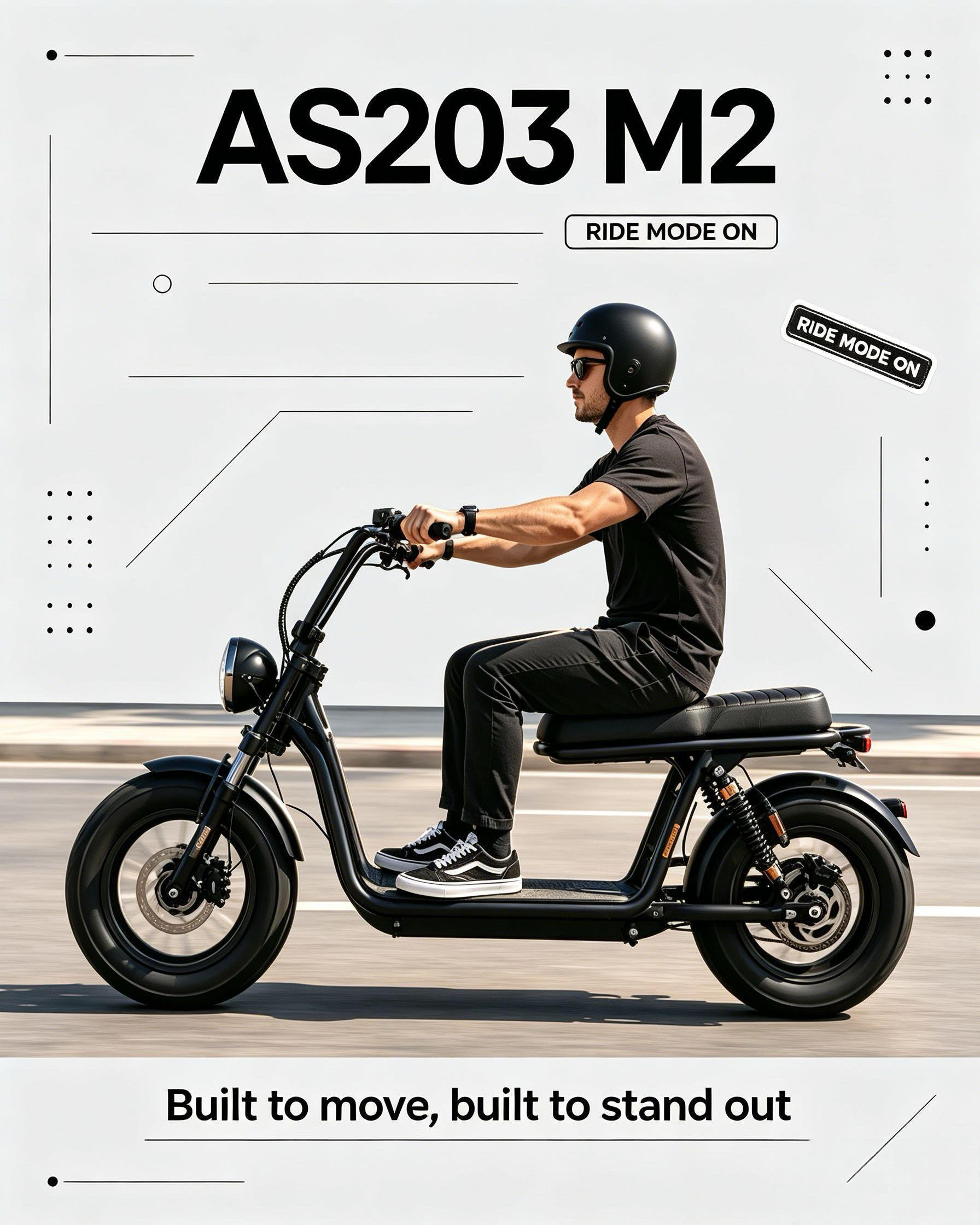
The AS203 M2 Wayfarer illustrates this product direction.
Its 20×4.0 tires, 60V platform, removable battery architecture, long bench seat, relatively long wheelbase, suspension and hydraulic braking are not independent selling points.
They form a complete vehicle concept.
The objective is to create a substantial, comfortable and performance-oriented riding experience.
The AS203 is therefore more useful as a case study in electric cruiser development than as another example of a generic e-bike.
The technical category and the legal category are not always the same.
In the United States, the CPSC’s federal bicycle definition includes fully operable pedals, an electric motor below 750W and a motor-only maximum speed below 20 mph under the specified test conditions.
Many U.S. jurisdictions also use Class 1, Class 2 and Class 3 concepts, but products outside those definitions can be regulated differently.
That means a high-power electric cruiser should not automatically be marketed as a conventional e-bike.
The same issue exists in Brazil. CONTRAN Resolution 996/2023 distinguishes electric bicycles from ciclomotors and other vehicle categories. The standard electric bicycle definition includes pedal assist, no manual accelerator, up to 1000W nominal power and motor-assisted speed up to 32 km/h, subject to the regulation’s provisions.
The next stage of electric mobility may be less about producing one universal type of e-bike and more about creating specialized vehicle categories.
Commuter bikes optimize efficiency.
Cargo bikes optimize carrying capacity.
Folding bikes optimize portability.
Performance electric cruisers place greater emphasis on stability, comfort, power and recreational riding.
That distinction gives manufacturers an opportunity to develop products around a complete riding experience.
The electric cruiser is therefore not simply a more powerful bicycle.
It represents a different approach to personal electric mobility.
What is a performance electric cruiser?
A performance electric cruiser is an electric two-wheel vehicle designed around comfort, stability, recreational riding and higher performance, often using wide tires, cruiser geometry, suspension and a higher-capacity electrical system.
What is the difference between an electric cruiser and an e-bike?
An electric cruiser generally places more emphasis on relaxed ergonomics, stability, wide tires and recreational riding, while conventional e-bikes often retain bicycle-oriented geometry and pedaling efficiency.
Why do electric cruisers use fat tires?
Fat tires provide greater air volume and can contribute to comfort and stability, although they also add weight and rolling resistance.
Is a 2000W electric cruiser an e-bike?
Not necessarily. Legal classification depends on the exact technical configuration and the regulations of the jurisdiction where the vehicle is used.