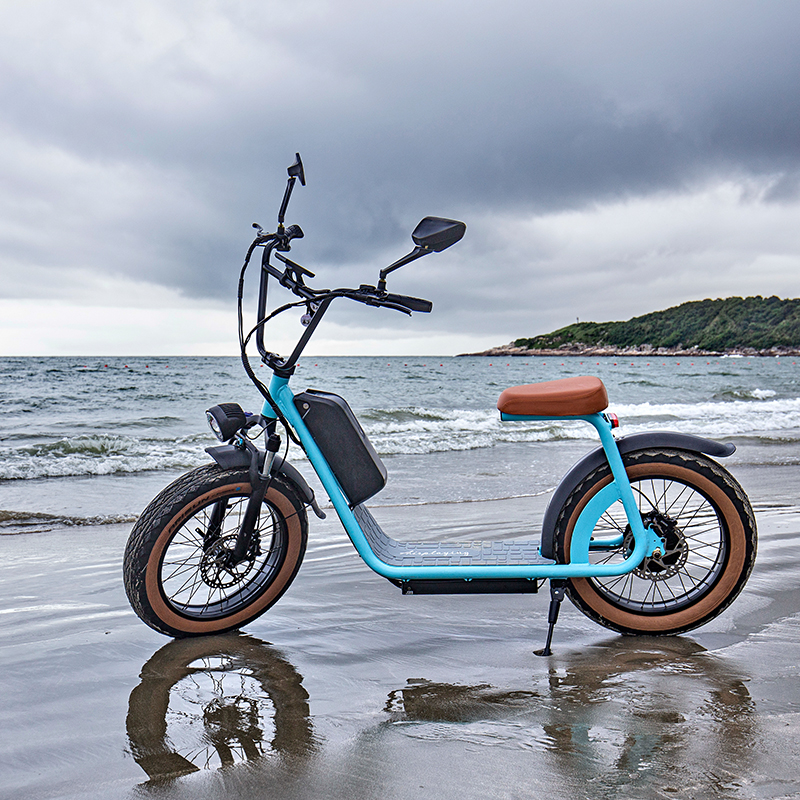
Product Type:Dual Battery
Product Introduction:Dual Battery Electric Scooters: How Two Batteries Increase Energy Capacity A dual battery electric scooter uses two battery pa...
A dual battery electric scooter uses two battery packs to increase available energy capacity.
The concept sounds simple, but a reliable dual-battery system requires careful consideration of electrical architecture, charging, battery matching, controller demand and physical integration.
The most obvious advantage is greater energy capacity.
For example, two 60V 25Ah battery packs can provide a theoretical combined capacity of:
60V × 50Ah = 3,000Wh
This does not mean the vehicle will automatically travel twice as far. Actual range depends on riding conditions and power consumption.
However, increasing available battery energy can significantly extend operating time when the system is correctly designed.
Removable batteries provide another advantage.
Instead of permanently installing a large battery pack inside the frame, two smaller battery packs can be removed independently.
This can make:
For B2B products, this can also simplify logistics and after-sales replacement.
Two batteries should not simply be connected together without considering their specifications.
Important factors include:
A dual-battery system should be designed as a complete electrical system.
Battery capacity and motor power are related but are not the same specification.
A 2,000W motor does not mean that the vehicle needs a 2,000Wh battery.
Motor power describes the powertrain’s output capability, while battery capacity describes stored energy.
The controller determines how much electrical current is demanded from the battery under different operating conditions.
Therefore, battery, controller and motor selection should be considered together.
Dual-battery architecture can be useful for products targeting:
It can also allow a single platform to support different battery configurations.
For example, an OEM customer may offer a standard single-battery version and a premium long-range dual-battery version without completely redesigning the vehicle.
Dual battery technology is not simply “twice the battery.”
The real engineering challenge is making two battery packs work reliably within the vehicle’s charging, BMS, controller and power architecture.