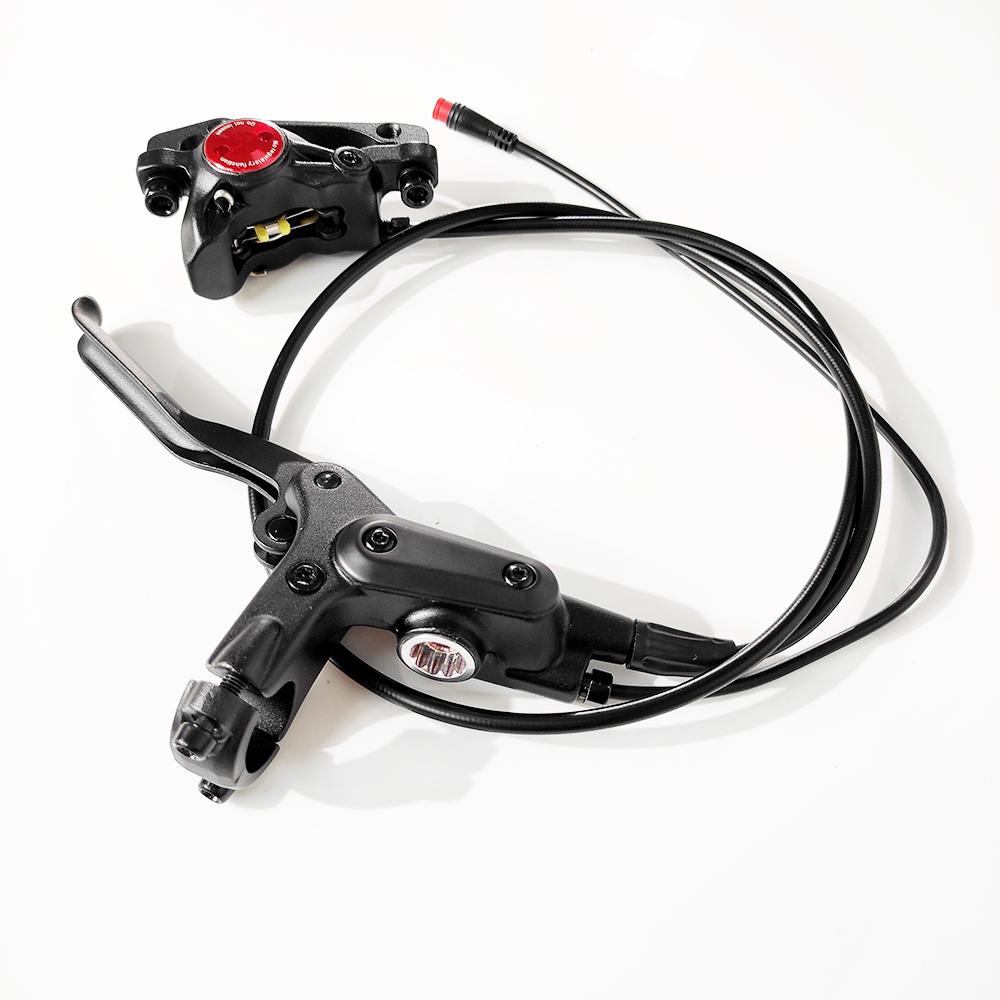
Product Type:Hydraulic Brakes
Product Introduction:Hydraulic Brakes for Electric Scooters: Why Brake Control Matters As electric scooters become heavier and faster, braking syst...
As electric scooters become heavier and faster, braking systems must handle greater kinetic energy.
Hydraulic disc brakes are widely used on performance-oriented electric scooters, electric bikes and electric cruisers because they provide strong braking force and precise control.
A hydraulic brake uses fluid pressure to transfer force from the brake lever to the brake caliper.
When the rider applies the brake lever, hydraulic pressure moves the caliper pistons against the brake pads.
The pads then clamp the brake rotor and convert the vehicle’s kinetic energy into heat.
The principle is simple, but the quality of the complete system matters.
Mechanical disc brakes use a cable to operate the caliper.
Hydraulic brakes use fluid pressure.
Hydraulic systems can provide:
Mechanical disc brakes can still be suitable for lower-power and lighter vehicles.
The correct choice depends on vehicle performance and target price.
The energy that needs to be dissipated during braking increases rapidly with vehicle speed.
Vehicle mass also plays a significant role.
This is why a high-power electric cruiser with a relatively heavy frame, battery and motor requires a more capable braking system than a lightweight urban e-bike.
Brake selection should therefore consider the complete vehicle specification.
A larger brake rotor can provide greater braking leverage and thermal capacity.
However, rotor size alone does not determine braking performance.
The system also depends on:
The tire remains the final contact point with the road. Extremely powerful brakes cannot compensate for inadequate tire grip.
Hydraulic brakes still require regular inspection.
Important maintenance points include:
For commercial fleets and high-use applications, maintenance planning should be part of product selection.
Hydraulic braking technology provides a strong combination of power and control for modern electric scooters and e-bikes.
For high-speed or heavier electric mobility products, hydraulic brakes can be an important part of the overall vehicle safety architecture.