Product Type:Product Comparisons
Product Introduction:Electric Cruiser vs. Traditional E-Bike: What Actually Changes? At first glance, an electric cruiser and an e-bike may appear ...
At first glance, an electric cruiser and an e-bike may appear to be the same type of vehicle.
Both can use lithium batteries, electric motors, digital displays and bicycle-style controls.
The difference becomes clearer when the vehicle is examined as a complete system.
A traditional e-bike is generally designed around cycling.
An electric cruiser is designed around riding.
That difference affects frame geometry, tires, seating position, suspension, braking and electrical architecture.
A conventional bicycle typically balances pedaling efficiency and handling.
A cruiser usually accepts a longer wheelbase and a more relaxed geometry.
The result is a different riding character.
The vehicle may feel more stable and predictable, but less responsive in tight turns.
This is a deliberate trade-off rather than a design flaw.
Cruiser geometry usually places the rider in a more upright position.
The seat and handlebar relationship is designed for comfort rather than aerodynamic efficiency.
This matters during longer recreational rides.
The rider is not required to maintain the forward-leaning position commonly found on performance bicycles.
A traditional e-bike may use narrow or medium-width tires to reduce rolling resistance.
An electric cruiser often uses much wider tires.
The 20×4.0 format has become particularly recognizable because it provides a compact wheel diameter while maintaining high tire volume.
A lightweight city e-bike may require only limited suspension.
A heavier electric cruiser needs a different approach.
Once vehicle weight, rider weight and speed increase, suspension becomes important for maintaining tire contact and controlling movement over uneven surfaces.
The same principle applies to braking.
More mass and greater speed increase the energy that must be dissipated during braking.
Therefore, the braking system must be designed together with the vehicle’s weight, tire grip and intended speed.
Hydraulic disc brakes are one solution, but brake performance depends on the complete system rather than the word “hydraulic” alone.
The electrical architecture also changes.
A conventional commuter e-bike can operate efficiently with a relatively modest motor and battery.
A performance cruiser may use a 60V system and a significantly higher power output.
This creates additional requirements for the battery, controller, wiring, thermal management and mechanical components.
The easiest way to understand the difference is to look at priorities.
| Conventional E-Bike | Electric Cruiser |
|---|---|
| Pedaling efficiency | Riding comfort |
| Lightweight design | Substantial chassis |
| Agile handling | Stable handling |
| Narrower tires | Wider tires |
| Urban commuting | Recreation + mobility |
| Moderate power | Performance-oriented power |
Neither category is inherently better.
They are designed for different riders and applications.
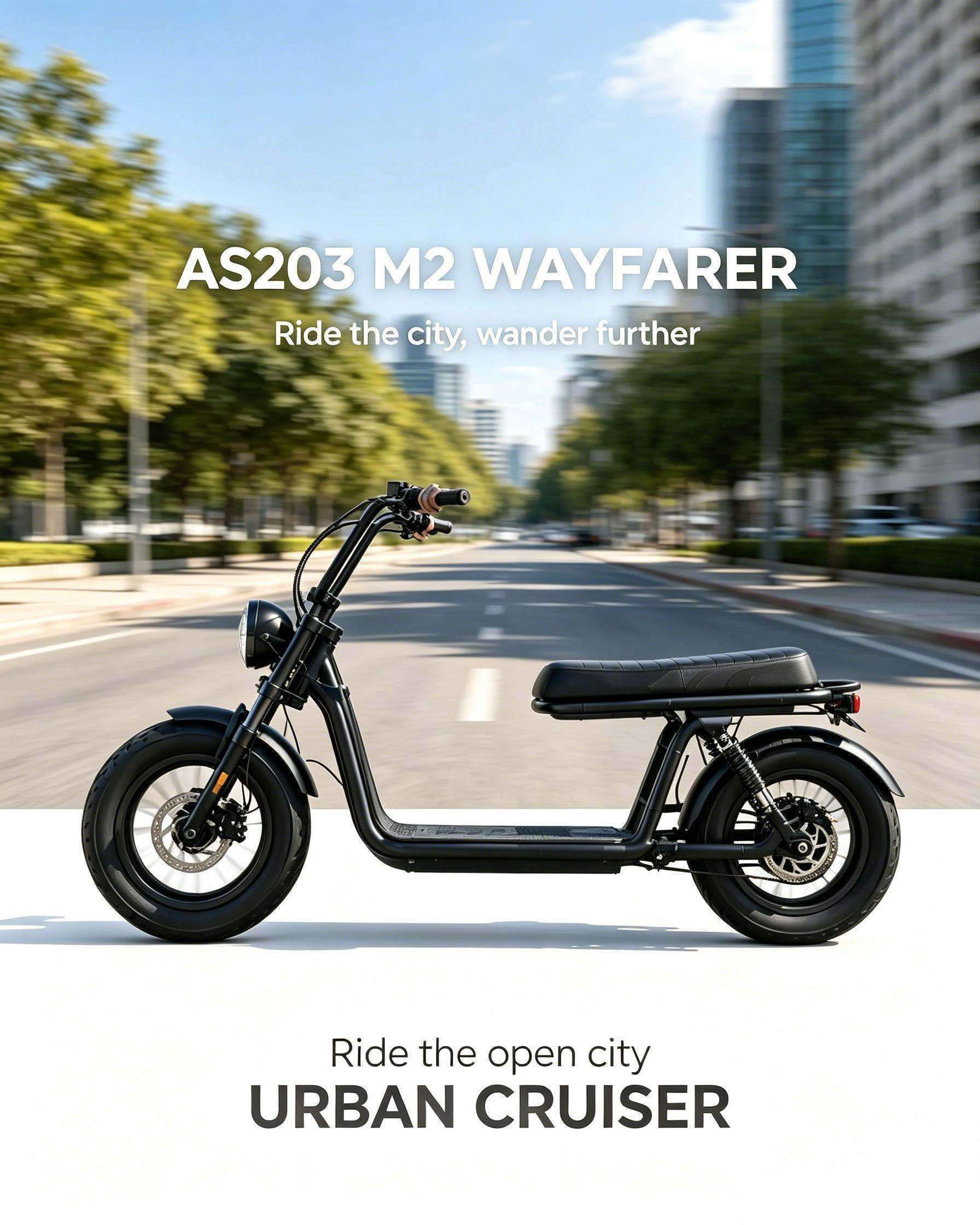
The AS203 M2 Wayfarer represents the second approach.
Its geometry, tire size, battery architecture and braking system are designed around the characteristics of a performance electric cruiser rather than a traditional bicycle.
Are electric cruisers heavier than e-bikes?
Many electric cruisers are heavier because they use larger tires, stronger frames, larger batteries and more substantial suspension and braking components.
Are electric cruisers more comfortable?
They can be, particularly for riders who prefer an upright position, wide tires and relaxed geometry.
Are fat tires better than regular bicycle tires?
Neither is universally better. Fat tires favor comfort and stability, while narrower tires generally favor lower rolling resistance and weight.